Updated 11-5-2026
As the fall and winter holidays approach and we prepare for big meals with family and friends, keep in mind that no one wants to spend time being ill from improper food handling.
There are four basic steps to preventing food poisoning all year long: clean, separate, cook, chill. The following list is basic and NOT all inclusive.
Clean: Always wash hands and work surfaces before, during, and after preparing food. This is especially important when you might be rotating through various dishes or cooking over a series of days.
Separate: This might be tricky when you have to find space for all the extra ingredients and dishes, especially a large turkey or ham. Remember to keep raw meat, fish, seafood, and eggs away from ready-to-eat foods both in the shopping cart and at home. Store raw meats on the lowest shelf of the refrigerator to reduce the chances of juices dripping down on other food. Also, use a different cutting board for fruits and vegetables than you do for raw meat. If you have to use one cutting board, cut all your fruits and vegetables first and then go to the meat. After each use, wash with hot, soapy water. You can also sanitize with a bleach dilution.
Cook: Cook all food thoroughly to recommended safe internal temperatures and do not consume any dough or batter that is meant to be baked or cooked. Flour is a raw food that has not been treated to kill germs like E. coli and Salmonella. Use pasteurized eggs in any recipe that does not involve fully cooking the eggs. Use a meat thermometer to check for internal temperature and rest cooked meat when applicable.
Chill: The “danger zone” for bacteria growth is between 40°F and 140°F. Make sure food is in the fridge or freezer within 2 hours of preparation. Dividing leftovers into small, shallow containers will help the food cool more quickly and also allow for safer reheating.
There are additional recommendations that apply specifically to this time of year when turkey is on many menus.
- Thawing the turkey – Never thaw turkey on the counter, or even in a cold space like the garage. There are three ways to safely thaw a turkey.
- Thawing in the refrigerator is the USDA recommended method because thawing will take place at a consistent, safe temperature. Leave the original wrapping on and place it into a container on the lowest shelf of the fridge. You will need to allow 1 day for every 4-5 pounds of weight, and once thawed, it will remain safe in the fridge for 2 additional days. For example, a 16 pound turkey will take 4 days to thaw in the fridge plus 2 days safe means you can start thawing 6 days before you want to cook it.
- Cold water: keep turkey in its original wrapping or a leak-proof plastic bag and submerge in a large container of cold water. Change the water every 30 minutes. Turkey will thaw at a rate of 1 pound in 30 minutes, so you would need 8 hours to thaw that 16 pound turkey. You will also need to cook it immediately when it is thawed.
- Microwave: if you have a large enough microwave (or small enough turkey) you can remove the wrapping and place the turkey on a microwave-safe dish. Follow the microwave instructions for what power level to use and how many minutes per pound it will take. The turkey will need to be rotated and flipped during thawing.
It is safe to cook a frozen or partially frozen turkey so if you have not left enough time to fully thaw the turkey, don’t panic. It will just take longer to reach the safe internal temperature of 165°F.
It is also not recommended to wash or rinse raw turkey. Cooking is the only way to kill bacteria and washing can result in splashing bacteria throughout the kitchen, including countertops, other food, and utensils. If any raw turkey or juices come into contact with kitchen surfaces, clean immediately with hot, soapy water and then a sanitizer.
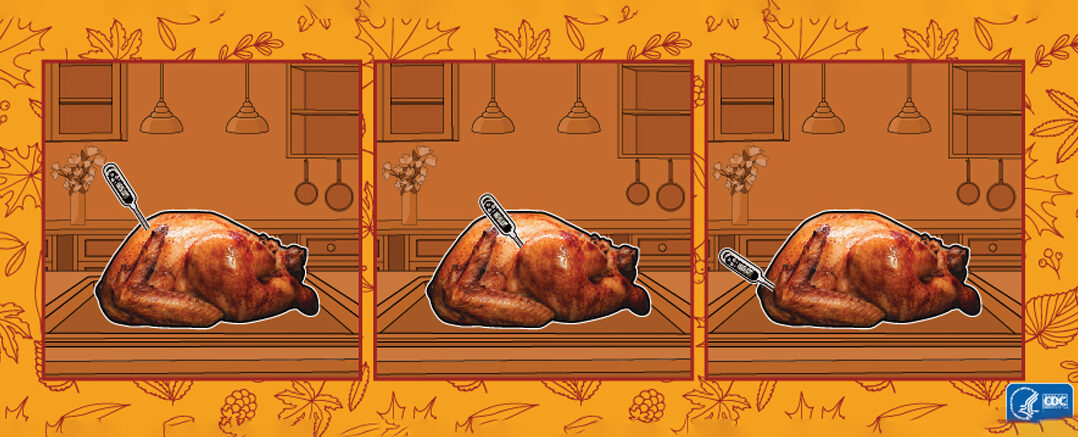
- Testing the internal temperature of the turkey – use a meat thermometer and there are 3 locations that you need to check for the meat to have reached safe temperature: the thickest part of the breast, the innermost part of the thigh, and the innermost part of the wing. Avoid hitting any bone when you test.
- If you plan to stuff your turkey, be aware that stuffing may not reach safe temperature at the same time as the turkey and undercooked stuffing can contaminate the cooked meat. If your stuffing recipe calls for any meat or shellfish, make sure those are cooked before they are stuffed into the turkey. Any stuffing prepared ahead of time needs to be cooked thoroughly and refrigerated in shallow containers until ready to go in the bird, and then the whole thing needs to be cooked immediately. Using a food thermometer, check that the internal temperature of both the turkey AND the stuffing has reached 165°F.
- Taking care of leftovers – refrigerate or freeze leftover food within 2 hours of preparation. Anything left out at room temperature for longer than 4 hours should be discarded. Large pieces of meat should be cut and stored in smaller containers so they cool more quickly. This will also help to quickly reheat them to the same 165°F safe temperature. Leftovers in the refrigerator should be eaten within 3-4 days. Frozen leftovers can be kept indefinitely but will be at best quality if used within 6 months. When thawing leftovers, the same safe methods that apply to the turkey apply to frozen food: refrigerator, cold water, or microwave.
When cooking ahead of time, all the same safety rules apply. Make sure food is stored in the fridge or freezer within two hours of preparation. In this case dividing portions among smaller containers will greatly reduce the amount of time required to reheat when it is time to serve.
Another important factor to plan is how you will safely transport cooked food if you are eating away from home. The adage “keep hot foods hot and cold foods cold” is key. Make sure sealed containers of food are packed to retain safe heat; if food is going to reach the “danger zone” (between 40°F and 140°F), make sure that doesn’t last more than 2 hours. It may be safer to cook ahead of time, chill and store appropriately until the event, and then reheat to the safe internal temperature of 165°F. When transporting cold food, it is just as important to keep it cold.
Every year an estimated 1 in 6 Americans gets sick from a food-borne disease during the Thanksgiving weekend. Start your holiday season out in the happiest – and safest – way possible: by eating well, enjoying family and friends, and avoiding food poisoning.
Find more information about food safety this season, and every season.